









Pepper the Giant Purple Dog







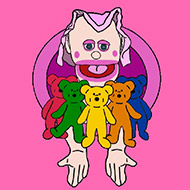


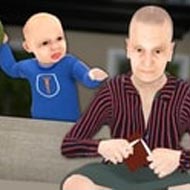


























What actually happens once the dog food runs out in Pepper the Giant Purple Dog? That question is the center of almost every player discussion about it, because the game spends its opening stretch pretending to be a simple pet-care sim before it stops pretending. This guide pulls together the caretaking loop, the named cast, the coin-collection sequence, and the practical habits that make a first run make sense.
| Genre | Mascot Horror, Virtual Pet Sim, Puzzle, Walking Simulator |
| Setting | Normalville |
| Perspective | First-person, presented as a game-within-a-game from 2002 |
| Core loop | Collect coins, buy dog food, care for Pepper, manage his hunger |
| Current status | Public demo available, full release planned for Q3 2026 |
Basic Movement and Interaction in Normalville
The demo runs as a standard first-person PC game, and the movement scheme players describe is the familiar layout: walk with the keyboard, look around with the mouse, and interact with objects and NPCs through a single context-sensitive prompt that appears when you’re close enough to something usable. There’s no combat system to learn and no stamina bar to manage, so the control footprint stays small on purpose. The exact bindings can be remapped from the settings menu, which is worth checking before your first run since the defaults aren’t documented anywhere outside the game itself.
Interaction in Normalville covers three repeatable actions tied to Pepper: feeding him with dog food bought using collected coins, bathing him, and walking him around a fixed loop near your house. None of these require precision or timing. The friction in Pepper comes from resource management and dialogue choices, not from reflexes, which is part of why the shift into horror territory later on catches new players off guard. They’ve been trained by the first act to expect a low-pressure control scheme, and the game never actually adds new mechanical complexity when things get darker. It just changes what the existing actions mean.
Exploration is limited to Normalville and the player character’s own house, and most players clear the walkable area within the first few minutes. Slower, more methodical players tend to get more out of this stretch, since talking to every NPC before the food crisis hits is the only way to catch dialogue that reads very differently on a second playthrough.
Oscar and the Rest of Normalville
Oscar is the only named human NPC in the demo, and he’s also the one who walks you through your responsibilities at the start: feed Pepper, bathe him, clean up after him, keep him happy. He reads as a friendly, slightly bland neighbor for most of the early game, which is exactly the point. Once the dog food runs out and Pepper starts demanding to be fed something else, Oscar becomes central to the game’s darkest choice. If the player kills him to satisfy Pepper, Oscar doesn’t react with fear. He treats it almost as relief, implying he’s been trapped in this loop with Normalville for longer than he’s let on.
The rest of the town is unnamed background NPCs who greet the player warmly and hand out small errands early on. Their dialogue starts to repeat or contradict itself once the hunger crisis begins, which a lot of players cite as the clearest environmental tell that Normalville was never as safe as it looked. None of them get names or backstories beyond Oscar, and the game leans into that anonymity rather than treating it as a gap.
Pepper: From Good Boy to the Game’s Real Threat
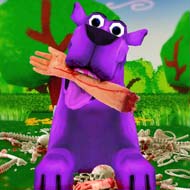
Pepper himself is a giant purple dog who can talk, and he’s an obvious visual riff on a certain oversized red children’s-book mascot, right down to the exaggerated size and the friendly first impression. For roughly the first half of the demo, that’s all he is: a big, needy pet whose care routine drives the entire loop. Once the food shortage hits, Pepper’s hunger stops behaving like a normal meter that resets with a purchase. It escalates, and he starts asking for something the shops in Normalville don’t sell.
What players find most unsettling isn’t the request itself but how calm Pepper stays while making it. He doesn’t threaten the way a typical horror antagonist does, at least not at first, and reviewers who compare him to his cheerful inspiration usually point to that contrast as the game’s sharpest trick. Quitting out of the game entirely does provoke a much more aggressive reaction from Pepper, and the demo’s ending sequence, where he appears to follow the player character out of the fiction of the game itself, is the single most discussed beat in early community reactions on forums and Discord.
The Watcher Near the Coins
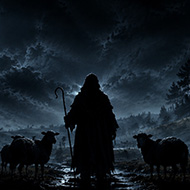
Coin collection is where Pepper the Giant Purple Dog borrows most directly from a different horror tradition. There are fifteen coins scattered around the map, needed to buy Pepper’s dog food, and collecting them introduces a tall, featureless humanoid figure that players immediately compare to Slender Man. The figure can’t move while you’re looking directly at it, so the coin-collection stretch becomes a slow, deliberate exercise in managing your own camera rather than running from anything.
Look away for too long, and it teleports you back to your house along with a short text message, effectively resetting your position without ending the run. It disappears for good once all fifteen coins are collected and never reappears afterward, which some players find like a strange, unresolved detour dropped into an otherwise tightly themed game. That’s a fair criticism, and it’s one of the more openly debated design choices in early discussion of the demo, since the figure has no stated connection to Pepper, Oscar, or anything else in Normalville.
- Fifteen coins total, tied directly to the dog food economy
- The watching figure freezes only while it’s in your direct line of sight
- Breaking eye contact for too long teleports you home instead of ending your run
What Beginners Get Wrong About the Hunger System
The most common early mistake is treating dog food purchases as unlimited and spending coins the moment they’re collected. The economy in Pepper is tight enough that a completionist approach, buying every available upgrade or extra bath item as soon as it appears, leaves you with nothing in reserve once the food supply runs dry and Pepper’s hunger stops responding to ordinary purchases.
The second mistake is skipping dialogue with Oscar and the background NPCs during the calm opening stretch. Casual players who rush the errands miss the small, early signs, an odd word choice here, a repeated line there, that make the later tonal shift feel earned rather than sudden. Horror-focused players who want the fourth-wall payoff at the end should plan on a slower, more attentive first pass through Normalville rather than speed-running the caretaking tasks.
A smaller detail that trips people up: cleaning up after Pepper isn’t optional flavor. It’s tied to its own achievement, and completionist players specifically call it out as one of the funniest, most grounded moments sitting right next to the game’s much heavier material.
Multiple Endings and How Routes Diverge
Once the hunger crisis begins, the game branches based on how you respond to Pepper’s demands. A pacifist route exists for players who refuse to feed him people, leaning instead into whatever alternative options the game allows during that stretch. Other routes follow Pepper’s request more directly and lead toward the darker endings the Steam content warning references. Neither path is framed as correct, and the demo doesn’t score your choices explicitly, leaving the moral weighing to the player.
What ties every ending together is the fourth-wall element after you quit: Pepper’s implied ability to leave the confines of the game and follow the player into the real world. That detail recontextualizes the “lost game from 2002” framing retroactively, since it suggests the player character was never just playing an old game safely from the outside.
Practical Tips From Early Players
Talk to Oscar and every background NPC before spending your first coin. The dialogue during the calm stretch is short and easy to miss, but it’s the only foreshadowing the game gives you before the tone shifts.
Ration your coin spending rather than buying dog food the instant you can afford it, since the food shortage arrives on a fixed schedule regardless of how efficiently you’ve played up to that point.
During the coin-collection sequence, keep the humanoid figure in view as much as possible rather than trying to outrun it, since the mechanic is built around sightlines, not speed.
If you’re aiming for the pacifist ending on a first attempt, expect the game to make that route feel deliberately less convenient than the alternative, since that friction is part of the point Pepper is making about the cost of doing the harder thing.
Mods, Updates, and the Road to a Full Release
As a small, recently released demo, Pepper doesn’t currently have an established modding scene, and there’s nothing resembling third-party content packs or gameplay overhauls in circulation yet. What exists instead is a steady stream of community walkthroughs, story-explainer videos, and Steam guides breaking down the ending branches, which function as the closest thing to supplementary content right now. The full version is planned for release later in 2026, and public messaging around it points toward expanded exploration, more live-action and illustrated sequences woven into the 3D game world, and a larger version of Normalville than the demo currently offers.
Because the demo is still being actively discussed and adjusted, players who want to stay current are better served checking the game’s own Steam page and community discussions than relying on secondhand summaries, since details about the hunger system and ending conditions have already shifted slightly between early builds.
How many coins do you need to collect in Pepper the Giant Purple Dog?
The demo requires collecting fifteen coins scattered around Normalville, which fund the dog food purchases that keep Pepper’s hunger under control during the early caretaking stretch. Once all fifteen are collected, the humanoid figure that appears during this sequence disappears and does not return.
Who is Oscar and what happens if you feed him to Pepper?
Oscar is the only named human NPC in the game, and he’s the one who explains the early care tasks to the player. If he’s killed and fed to Pepper during the hunger crisis, he reacts with resignation rather than fear, suggesting he sees it as an escape from Normalville rather than a tragedy.
Does Pepper the Giant Purple Dog have a pacifist ending?
Yes. Players who refuse to feed Pepper people during the hunger crisis can follow a pacifist route through the remaining choices, though the game does not make that path mechanically easier than the alternative, and every ending includes the same fourth-wall moment after quitting.
However a first run through Normalville turns out, Pepper the Giant Purple Dog is built so that small details, Oscar’s throwaway lines, the fifteen scattered coins, the stool-cleaning achievement, all pay off once the game stops being a caretaking simulator and starts asking what you’re willing to do to keep a good boy fed.

Comments
There are no reviews yet. Be the first one to write one.